

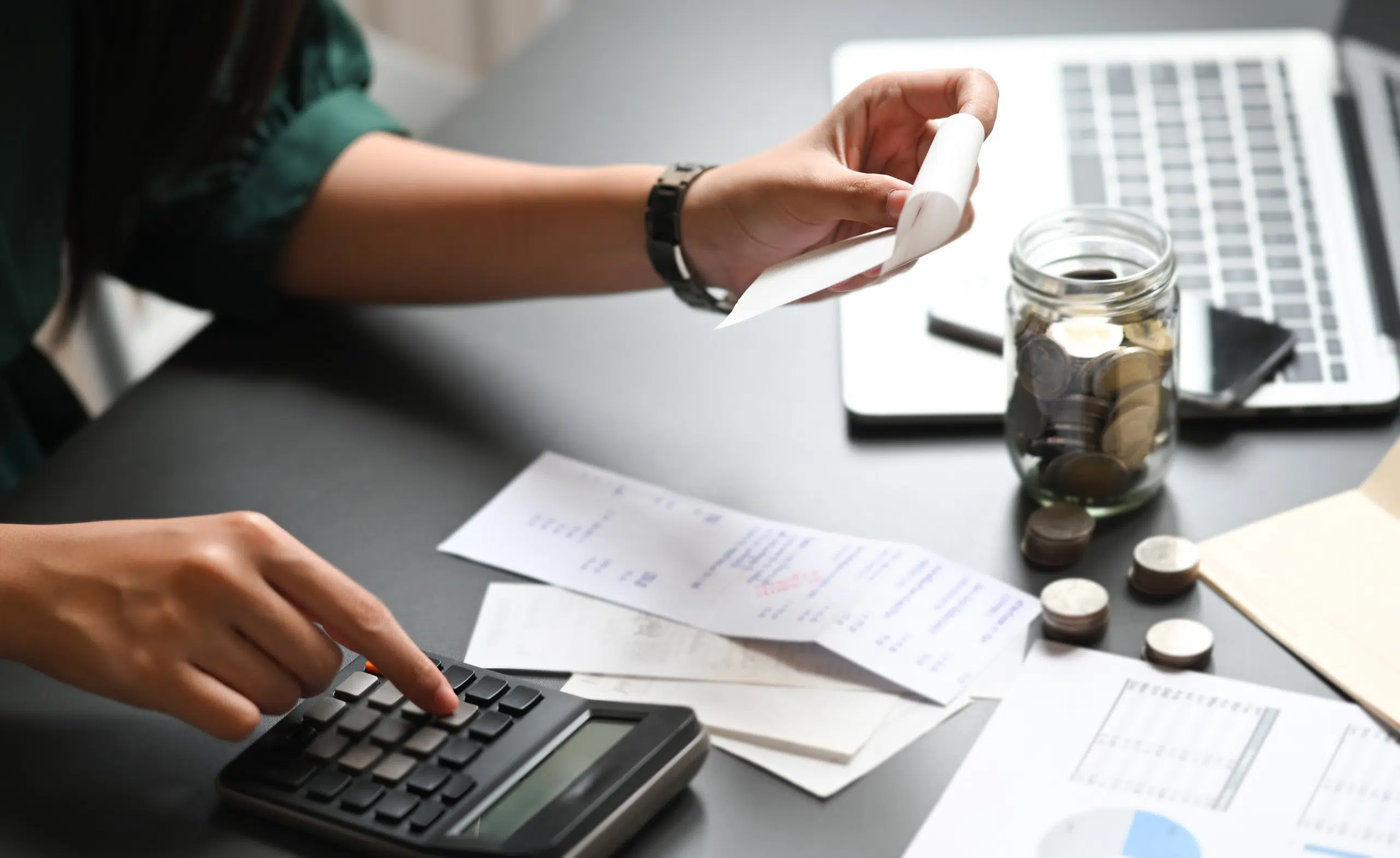
In Switzerland, a business can deduct expenses justified by its business activity. These include premises, software, equipment, advertising and travel to clients. Private expenditure remains your responsibility. Where a purchase has both uses, only the business share can be taken into account.
But how do you decide for a meal, telephone or car? The name on the invoice is not enough. Below are common expenses, the evidence to retain and examples to help you decide what to record in your accounts.
Article contents
At a glance
- Explain the business connection. Paying with the company card does not make a purchase deductible.
- Separate private and business use. A phone or vehicle is not always used entirely for work.
- Keep the invoice and the context. For a client meal, also record the participants and purpose of the meeting.
- A deduction is not a reimbursement. The expense reduces taxable profit, not the tax bill by the same amount.
When is an expense deductible?
Start with this question: what purpose does this expense serve in my business? “I needed it to prepare the building plans” is an explanation. “The invoice is in my company’s name” is not.
Swiss tax law refers to commercially justified expenses. For self-employed people, this rule is set out in Article 27 of the Direct Federal Tax Act (in French). For an LLC or limited company, Articles 58 and 59 (in French) likewise exclude charges without business justification. Check cantonal details for your circumstances.
Your occupation does not decide everything
A butcher can buy graphic design software to create posters. A consultant can have the office floor repaired. Their occupation does not prohibit these expenses: actual use matters. By contrast, renovating the consultant’s private bathroom does not become a business expense.
For each purchase, check three points: its business connection, any private-use share and the available evidence. Then decide whether it is an expense for the year or an investment to depreciate.
Common business expenses
This table provides reference points, not automatic permission. The same category can include both business and private expenditure.
| Expense | Business examples | What to check |
|---|---|---|
| Premises | Office or workshop rent, energy, cleaning and repairs. | Actual business use. Improvements with a lasting benefit may be an investment. |
| Equipment and software | Computer, tools, industry software subscriptions and website hosting. | Any private-use share and the treatment of durable purchases. |
| Travel | Train to a meeting, hotel during an assignment and business vehicle expenses. | Date, destination and purpose. Exclude holidays and private journeys. |
| Meals and entertainment | A business meal with a client or costs connected with a commercial meeting. | Participants, business purpose and an amount appropriate to the circumstances. |
| Marketing | Advertising, website creation, printed materials and trade fairs. | Services actually provided to the business. Review gifts or personal-use expenditure separately. |
| Administration | Accounting fees, business legal advice, bank fees and office supplies. | Business connection and separation of any private services. |
| Staff and insurance | Salaries, employer contributions, professional liability insurance and employees’ professional training. | Correct payroll and insurance treatment. Distinguish private premiums from business coverage. |
For personnel expenses, see also Swiss social security contributions. A self-employed person’s contributions and personal deductions are not all treated like an LLC’s expenses.

Which expenses can your business pay?
On our French-language channel “Entreprendre en Suisse avec Sarah et Romain”, Romain explains LLC and limited-company expenses, travel and business entertainment.
Useful chapters: 0:55, deductible expenses ; 6:34, vehicles ; 12:35, depreciation ; 13:40, expense claims and business entertainment.
Separate business and private use
A telephone subscription is used to call clients, but also family. You do not have to choose between deducting everything and nothing: use a defensible business-use proportion.
Example: Claire’s phone
Claire is a sole proprietor and is not VAT-registered. Her subscription costs CHF 1,200 a year. Based on documented use, she allocates 70% to her business.
- Business share: 1,200 × 70% = CHF 840.
- Private share: 1,200 − 840 = CHF 360.
She keeps the invoices and a note explaining the allocation. The 70% is an assumption in this example, not a Swiss tax allowance. Different usage may justify a different proportion.
Meals: consider the circumstances
Lunch with a client to discuss an assignment may be a business expense. Record who attended and the meeting’s purpose. Your usual lunch alone near your workplace does not become a business meal because you worked that morning.
For a self-employed person travelling on business, assess additional costs caused by the assignment and the applicable rules. Do not automatically copy employee meal allowances into a sole proprietorship’s accounts.
Cars: avoid double counting
A company-owned car and a private car used to visit clients are treated differently. Keep business travel records and apply the appropriate treatment. Do not combine a mileage reimbursement with all actual costs to cover the same use twice.
If the business provides a car for private journeys, the benefit must be addressed. Our article on company car private use explains the calculation and the distinction between employees and self-employed people.
Home office: justify the space used
Occasionally working at the kitchen table does not make the rent for your entire apartment a business expense. Document the space actually used for the business and the allocation of costs. Conditions and treatment depend on factors including legal form, room usage and cantonal practice. No single rent percentage applies to everyone.
How much tax do you actually save?
A deduction reduces taxable income or profit. It does not reimburse your purchase. Return to Claire’s CHF 840 of business expenses.
Assume, solely for this example, a constant marginal tax rate of 25%. The deduction saves 840 × 25% = CHF 210 in tax. Claire still has to pay CHF 1,200 for the subscription. After the tax saving, its total cost remains CHF 990, including CHF 360 for private use.
This simplified calculation isolates income tax. It excludes any effect on AHV/AVS contributions and does not represent every reader’s tax rate. The actual outcome depends on income, canton and personal circumstances.
To understand where expenses fit in, read our explanation of how business profit is calculated.
Expense or investment?
A monthly subscription and a machine used for several years both relate to the business, but they are not necessarily recorded in the same way.
A durable item may need to be recognised as a fixed asset, meaning an item the business uses over time. Its cost is then allocated through depreciation. Paying the full amount today does not necessarily mean deducting it all this year.
For example, a CHF 12,000 production machine expected to last several years must be assessed as an investment. Treatment depends on the asset, useful life and applicable accounting and tax rules. Standard FTA rates do not replace that analysis; some cantons also apply special methods.
For a computer: check business use, the private share and the appropriate accounting treatment. Avoid the invented rule that “every IT purchase is immediately deductible”.
Prepare a useful expense claim
An expense claim is used, among other things, to reimburse a business expense paid with personal funds. It connects the supporting document with the person, assignment and reimbursement.
Record the date, supplier, expense type, amount, currency, business purpose and who paid. Attach invoices or receipts. For travel, add the route; for a meal, the participants. A bank statement proves a payment but rarely explains what was purchased.
A completed example
Fictional situation · illustrative amounts
Léa, an LLC employee, visits a client for a project kickoff meeting. She pays for a train ticket and a business meal with the client.
| Expense claim dated 15 October | Amount |
|---|---|
| Geneva–Lausanne return train journey for the client project kickoff. Ticket attached. | CHF 48 |
| Meal with the client. Itemised receipt, participant’s name and meeting purpose attached. | CHF 86 |
| Total business expenses to reimburse | CHF 134 |
The LLC checks the claim against its expense policy. If Léa already received an advance of CHF 100, the remaining reimbursement is 134 − 100 = CHF 34.
How do you record the reimbursement?
Assume the LLC is not VAT-registered and no advance was paid. In double-entry bookkeeping, the approved CHF 134 claim produces:
- The expense: debit travel expenses CHF 48 and business entertainment CHF 86; credit the amount payable to the employee CHF 134.
- The reimbursement: debit that payable CHF 134; credit Bank CHF 134.
The transfer clears the liability: it does not create a second expense. Any advance must be reconciled with the claim and remaining balance. Adapt account names to your chart of accounts.
Who sets the rules?
For employees, Article 327a CO requires reimbursement of expenses necessarily incurred in performing the work. An expense policy clarifies eligible costs, approval and evidence. For flat-rate allowances, use the current Swiss Tax Conference models (in French) and assess approval by the canton of the registered office. An allowance is not a way to freely reclassify salary as expenses.
Keep accounting records for ten years from the end of the financial year, under Article 958f CO. Electronic storage must preserve their connection to the transaction and long-term readability.
Good records also support cost accounting: allocating expenses to activities is easier when the purpose and supporting evidence are clear.
When the business pays a private cost
You accidentally use your LLC’s card for a CHF 120 personal purchase. Do not invent a business reason. Report the mistake and reimburse the company in a traceable way.
- In an LLC or limited company: a one-off mistake can be recorded as an amount due from the shareholder, then cleared on repayment. It must not remain a deductible expense.
- In a sole proprietorship: private expenditure paid from the business account is an owner’s drawing and does not reduce business profit.
If a company regularly bears personal expenses, the issue is different. Depending on the facts, this may constitute a salary benefit or concealed profit distribution, with tax and potentially social-insurance consequences. A bookkeeping entry alone does not resolve everything.
A separate business bank account and dedicated card help prevent mixing funds. To understand how business and personal assets relate in self-employment, see our article on sole proprietorships.
What about VAT on your purchases?
Deducting an expense for profit tax and recovering VAT are two separate checks.
A VAT-registered business using the effective reporting method can, subject to conditions, deduct VAT on business purchases as input tax. Entitlement depends particularly on the activity the purchase serves. Private use or an activity exempt without input-tax credit may restrict or prevent the deduction.
Example: a business service costs CHF 1,000 plus CHF 81 VAT at the standard 8.1% rate, giving CHF 1,081 to pay. If the business is entitled to full input-tax deduction, it records a CHF 1,000 expense and CHF 81 deductible VAT. It does not deduct both a CHF 1,081 expense and CHF 81 input tax.
If it is not VAT-registered, the VAT cannot be recovered: CHF 1,081 forms the business expense’s cost. Under the net tax rate method, input tax is generally taken into account in the authorised rate, without ordinary invoice-by-invoice deduction.
Check your registration position and the Swiss VAT rules before copying a calculation. An “expense reimbursement” label on a transfer does not, by itself, establish entitlement to input-tax deduction.
Conclusion
To treat expenses correctly, start with the actual purchase: what is it for, who uses it and what evidence can you retain? Then separate private use, review investments and record each expense only once.
Record this information when you make the purchase, not the day before year-end closing. For expenses that are difficult to allocate, agree the method with your accountant before repeating it throughout the year.
Frequently asked questions
Which expenses can a Swiss LLC deduct?
Expenses justified by its business activity, such as premises, equipment, software, marketing, professional fees, salaries or business travel. Document their use, exclude or properly treat private use, and distinguish current expenses from investments to depreciate.
Which expenses can a sole proprietor deduct?
A self-employed person can deduct expenses justified by their business activity. Personal and family expenditure does not reduce business profit. Money withdrawn for living costs is not a deductible salary paid to oneself.
Are all meals deductible for a self-employed person?
No. A business meal and an ordinary lunch are treated differently. Document the business purpose and participants. When travelling, assess additional assignment-related costs and the applicable rules; do not automatically copy employee allowances.
Can my company pay for my holidays?
Private holidays are not deductible business expenses. If a stay genuinely combines work and holidays, separate the costs and justify the business share. One meeting during a holiday does not turn the whole stay into a business trip.
When must an expense claim be reimbursed?
For an employee, Article 327c CO provides for reimbursement with salary, based on the submitted statement, unless a shorter period is agreed or customary. If the work regularly entails expenses, the employer must provide a suitable advance at set intervals and at least monthly.
Can I deduct an expense without an invoice?
Without sufficient evidence, the deduction may be refused. First request a duplicate from the supplier and gather evidence of the nature, amount and business purpose. A bank statement or a note written later does not alone guarantee tax acceptance.
Can a computer be deducted immediately?
Not always. Assess business use, the private share and the appropriate accounting treatment. Depending on the circumstances, the computer must be capitalised and depreciated. Paying in one instalment does not determine immediate tax deductibility.
Can a self-employed person apply employee allowances?
Not automatically. Employees’ personal deductions, employer expense reimbursements and self-employed business expenses follow different rules. Check the regime and cantonal practice applicable to your circumstances.
Sources and references
The French article’s rules and sources were checked on 15 October 2026. Examples are fictional; allocation percentages are not official allowances.
- Direct Federal Tax Act, Articles 27, 28, 34, 58 and 59 (in French): business expenses, depreciation and non-deductible expenditure.
- Geneva tax administration: 2025 self-employed tax return (in French): examples of overheads. A cantonal reference, not a rule to apply indiscriminately across Switzerland.
- FTA depreciation leaflet for commercial businesses (in French): normal rates and special cantonal methods.
- Code of Obligations, Articles 327a, 327c and 958f: employee expense reimbursement and record retention.
- Swiss Tax Conference expense policy models, updated on 1 January 2026 (in French): reimbursements and allowances.
- VAT Act, Articles 28–30 and 37: input tax, mixed use and net tax rates.

Romain Prieur is a Swiss certified public accountant and the founder of Entreprendre.ch. With more than ten years of experience in auditing and supporting businesses in Switzerland, he advises entrepreneurs on company formation, accounting and taxation.


