


Starting a Swiss LLC while keeping your salaried job is a common way to test a business idea while retaining employment income. But one question deserves attention before you register the company: could becoming a managing shareholder affect your unemployment benefit if you lose your main job?
The answer depends first on where the lost employment was. Losing a job with an employer independent of your LLC is different from stopping the salary paid by your own company. This article concerns Swiss unemployment insurance; cross-border workers may need to claim in their country of residence instead.
Five points to understand first
Forming an LLC does not automatically cancel your entitlement. If you lose a salaried job with a separate employer, unemployment benefit may still be available.
Your availability for work remains essential. The unemployment insurance fund and regional employment centre will examine the time spent on the LLC and your ability to accept a new job.
Losing a salary from your own LLC is different. Benefit for that loss is generally refused while you retain an employer-like position and decisive influence over the company.
Paying unemployment insurance contributions does not guarantee benefit. Contributions are collected on salary, but your position as a managing shareholder is still assessed.
Contributions do not count indefinitely. The fund normally examines qualifying employment within the two-year contribution reference period before entitlement begins.
You may be able to receive Swiss unemployment benefit while remaining a managing shareholder of an LLC if you have lost a salaried job with an independent employer. You must disclose the company activity, meet the contribution conditions and remain genuinely available for new employment.
Can a managing shareholder of a Swiss LLC claim unemployment benefit?
In some situations, yes. Being a managing shareholder does not by itself remove every right acquired through salaried work for a separate employer. A Swiss LLC is known as a Sàrl in French and a GmbH in German.
The SECO unemployment benefit directive (French) explains that a person who loses a job in which they had no employer-like decision-making powers is not automatically excluded because they hold such a position in another business.
The fund must still examine whether the person is available for placement. In practice, are they willing and able to take suitable employment, or have they committed themselves to developing their own company? The regional employment centre is called the RAV in German-speaking Switzerland and the ORP in French-speaking Switzerland.
The two situations to distinguish
1. You lose a salaried job with an independent employer
Suppose you work full-time for a bank, an SME or a public employer. Alongside that job, you set up an LLC and work on it in the evenings or at weekends. If your employer dismisses you, keeping the LLC does not necessarily prevent a claim.
Under SECO directive B30, a person who retains an employer-like position in one company and claims for a lost salaried job in another must have held that other insured job for at least six months and meet the minimum 12-month contribution requirement. The general contribution reference period is two years. Ask the fund to assess the dates of your jobs and company activity together.
The fund will also examine the scale of the LLC: working hours, client contracts, investment, premises, employees and earnings, as well as whether you can promptly reduce or stop this activity to accept employment.
2. You stop working for your own LLC
The position is much more restrictive when the lost salary was paid by your LLC. Under Swiss law, LLC shareholders have significant decision-making rights. They may influence their own appointment, pay and possible re-employment.
A managing shareholder who stops taking a salary, reduces working hours or terminates their own employment while retaining control therefore generally cannot claim unemployment benefit for that loss.
This rule addresses the risk of abuse, not only proven abuse. It can apply even when the company has no revenue and the individual has paid unemployment insurance contributions for several years.
Must you resign as manager or sell your LLC shares?
If your claim follows the loss of a job with a separate employer, you do not automatically have to resign as manager or sell your shares. You must disclose your role and keep the company activity compatible with your availability for work.
If the lost job was in your own LLC, simply terminating the employment contract is generally insufficient. Resigning as manager while remaining a shareholder may also be insufficient because shareholders retain decision-making rights at the members’ meeting.
A permanent departure needs clear evidence, such as an effective share transfer, the end of the management role, removal of signing authority and the corresponding changes in the commercial register. A sale, closure or bankruptcy may also end the employer-like position, depending on the circumstances. No single formality guarantees benefit: the fund examines whether your influence has genuinely and permanently ended.
Take care: placing the company into liquidation or temporarily stopping business may not be enough. A person who remains a liquidator or can reactivate the company may still hold an employer-like position.
How is income from the LLC treated?
Company revenue and profit
The LLC is a separate legal entity. Its revenue and profit are not automatically the shareholder’s personal income. They can nevertheless help the fund assess the scale and development of the business activity.
Salary and other remuneration
Any salary paid by the LLC must be disclosed. Salary earned while receiving unemployment benefit may be treated as interim earnings and reduce the compensatory benefit. The fund can also check whether the pay reflects the work performed and the customary rates for the occupation and locality. Interim earnings from genuine self-employment generally do not create new unemployment insurance contribution periods; employment through an LLC requires its own classification.
Dividends
A dividend is a return on share ownership and differs from salary. Paying dividends does not remove the shareholder’s decision-making powers. Social insurance authorities may also reassess remuneration that has been artificially relabelled as a dividend. Our article on salary versus dividends explains the distinction.
Unpaid work for the company
Receiving no pay does not mean that no work is taking place. Time spent finding clients, handling administration or delivering services can reduce the recognised loss of working time and affect availability for employment. In some cases, the fund may also examine the customary remuneration for the work performed.
Do earlier unemployment insurance contributions still count?
Forming an LLC does not erase previous contributions. However, those contributions are not held as an unlimited balance for future claims.
When a claim begins, the fund normally examines the two years preceding the first day on which the eligibility conditions are met. Usually, at least 12 months of qualifying salaried employment are required within that period. The general conditions are explained in the official arbeit.swiss unemployment benefit FAQ.
Remember: a long employment history is not an indefinite reserve of entitlement. Employment normally counts only if it falls within the contribution reference period, subject to any statutory extension or exception.
Someone who worked and contributed continuously for more than two years up to dismissal will usually satisfy the minimum contribution requirement. That alone does not establish entitlement if they are unavailable for work or are claiming for a lost salary from their own LLC while retaining control.
Does paying yourself an LLC salary change the position?
Salary from an LLC is generally treated as employment income for social insurance purposes. The company deducts contributions including OASI/AHV, DI/IV, income compensation and unemployment insurance. For a wider overview, see our article on Swiss social security contributions.
. These payments do not make a managing shareholder independent of the employer’s decisions. If you control the LLC, you may determine your salary, working time and re-employment. That influence is precisely what limits unemployment benefit when the lost job is in your own company.
If an LLC salary already accompanied a full-time main job, it may qualify as pre-existing secondary earnings. Unchanged secondary earnings do not automatically become interim earnings during unemployment. If the activity or remuneration increases, however, the additional part may affect benefit. Report any increase in working time or pay promptly.
The practical point: taking a salary can support social insurance and pension coverage, but it does not guarantee future unemployment benefit from the loss of your own company salary.
Three practical examples
Example 1: the LLC remains a side activity
Marc works full-time for an IT company and spends five hours a week on his LLC. His main employer dismisses him. He can apply for unemployment benefit without automatically selling his shares, but must disclose the LLC, satisfy the employment conditions and demonstrate that he remains available for a new full-time job.
Example 2: the business grows after dismissal
After dismissal, Marc starts spending three days a week on the LLC and looks only for a 40% job. The compensated loss of working time may be reduced. If his business commitments prevent him from accepting suitable employment, his availability for placement may be challenged.
Example 3: the lost salary came from the claimant’s own LLC
Sophie is the sole shareholder, manager and employee of her LLC. Orders fall, and she stops taking a salary while keeping her shares and signing authority. Despite the contributions paid, she generally cannot obtain unemployment benefit for that lost salary while retaining her employer-like position.
Checklist before forming an LLC alongside employment
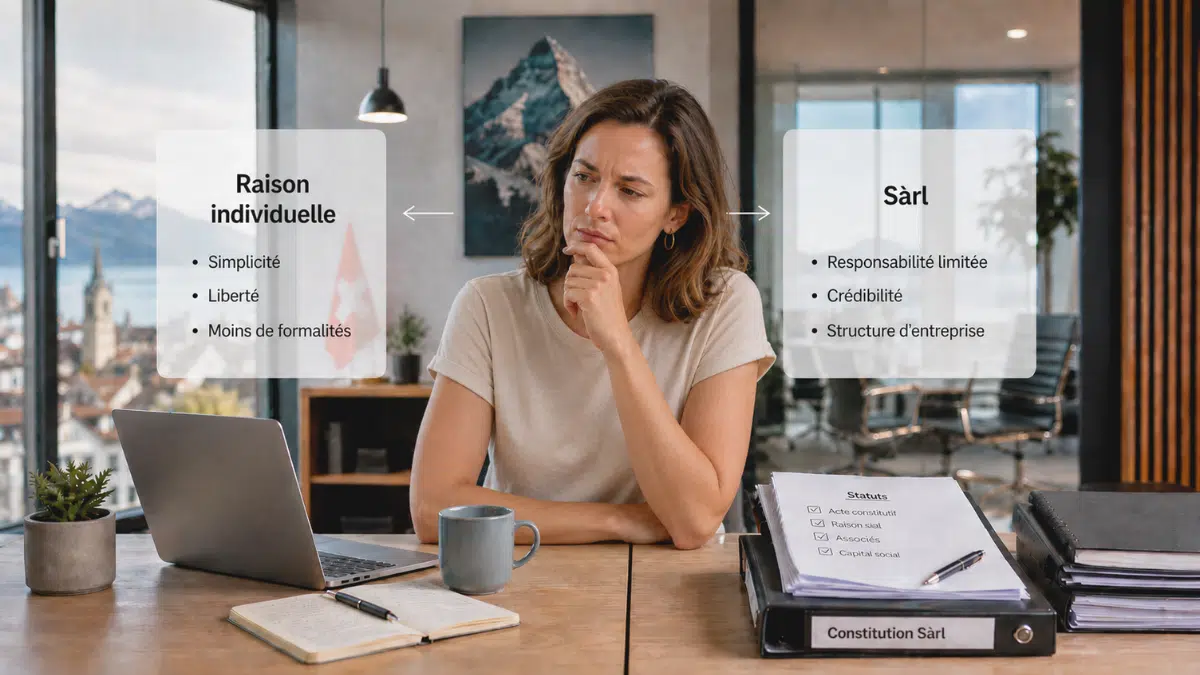
If you are still choosing a business structure, our comparison of a sole proprietorship and a Swiss LLC also covers liability, taxation and social insurance.
If you have already chosen, you can begin forming your Swiss LLC with support from our Swiss certified accounting experts.
Keep your main employment and company activity clearly documented
Becoming a managing shareholder does not automatically cancel rights acquired through employment with a separate employer. A claim may remain possible when the lost job is genuinely independent, the contribution conditions are met and the business activity remains compatible with an effective job search and availability for work.
Unemployment insurance generally does not cover the entrepreneurial risk of a managing shareholder who reduces or stops their own salary while retaining control. Paying contributions alone does not overcome that restriction.
Before you set up your LLC in Switzerland, distinguish your main employment from your side activity and document your remuneration and working time. If a claim becomes necessary, disclose the full situation from the outset.
Reviewed against official information available on 22 September 2026. This article provides general information; the competent unemployment insurance fund and cantonal authorities assess individual eligibility.
FAQ: Swiss LLC shareholders and unemployment benefit
Can a managing shareholder of a Swiss LLC receive unemployment benefit?
A claim may be possible after losing salaried employment with a separate employer. The fund checks contributions, the duration and circumstances of that employment, and your genuine availability to take another job.
Can a minority shareholder claim unemployment benefit?
For a lost job in your own LLC, shareholder status can be enough to create an employer-like position under Swiss practice. If the lost job was with an independent employer, availability for placement and the other eligibility conditions must be assessed.
Do I have to resign as manager to claim unemployment benefit?
Not necessarily if you lost a job with a separate employer. Resigning only as manager may, however, be insufficient when the lost employment was in your own LLC and you remain a shareholder.
Must I sell my LLC shares to regain eligibility?
An effective share sale may be needed to demonstrate the permanent end of an employer-like position in your own company. Management duties, signing rights and any other continuing influence must also be considered. Eligibility is not guaranteed by the sale alone.
Does paying myself an LLC salary entitle me to unemployment benefit?
Salary is generally subject to unemployment insurance contributions, but these do not guarantee benefit while a managing shareholder retains control over the company. The actual position in the business remains decisive.
How is an LLC salary treated while I am unemployed?
You must declare it. It may count as interim earnings and reduce benefit. If it was already genuine secondary income before unemployment and remains unchanged, a different treatment may apply.
Does my LLC's revenue or profit reduce unemployment benefit?
Revenue and profit belong to the LLC and are not automatically personal income. They may still help the fund assess the scale of the business activity and your availability for employment.
Do earlier contributions still count after I form an LLC?
Forming the LLC does not erase contributions. The fund normally examines the two years before entitlement begins and requires at least 12 months of qualifying employment within that period, subject to statutory exceptions.
Can I claim if the LLC has no revenue?
No revenue does not establish entitlement. The fund also considers working time, business development, investment and whether you can promptly accept salaried employment.
Who decides whether I am entitled to unemployment benefit?
The unemployment insurance fund assesses entitlement and calculates benefit. The regional employment centre or competent cantonal authority may also examine availability for placement and work.

Founder of Entreprendre.ch, Romain helps Swiss entrepreneurs establish and manage their companies, from LLCs to limited companies. He makes administrative, accounting and tax matters easier to understand.
Related articles


Preparing to form your Swiss LLC?
Set up your company with support from Swiss certified accounting experts, or discuss your structure and remuneration before getting started.


