

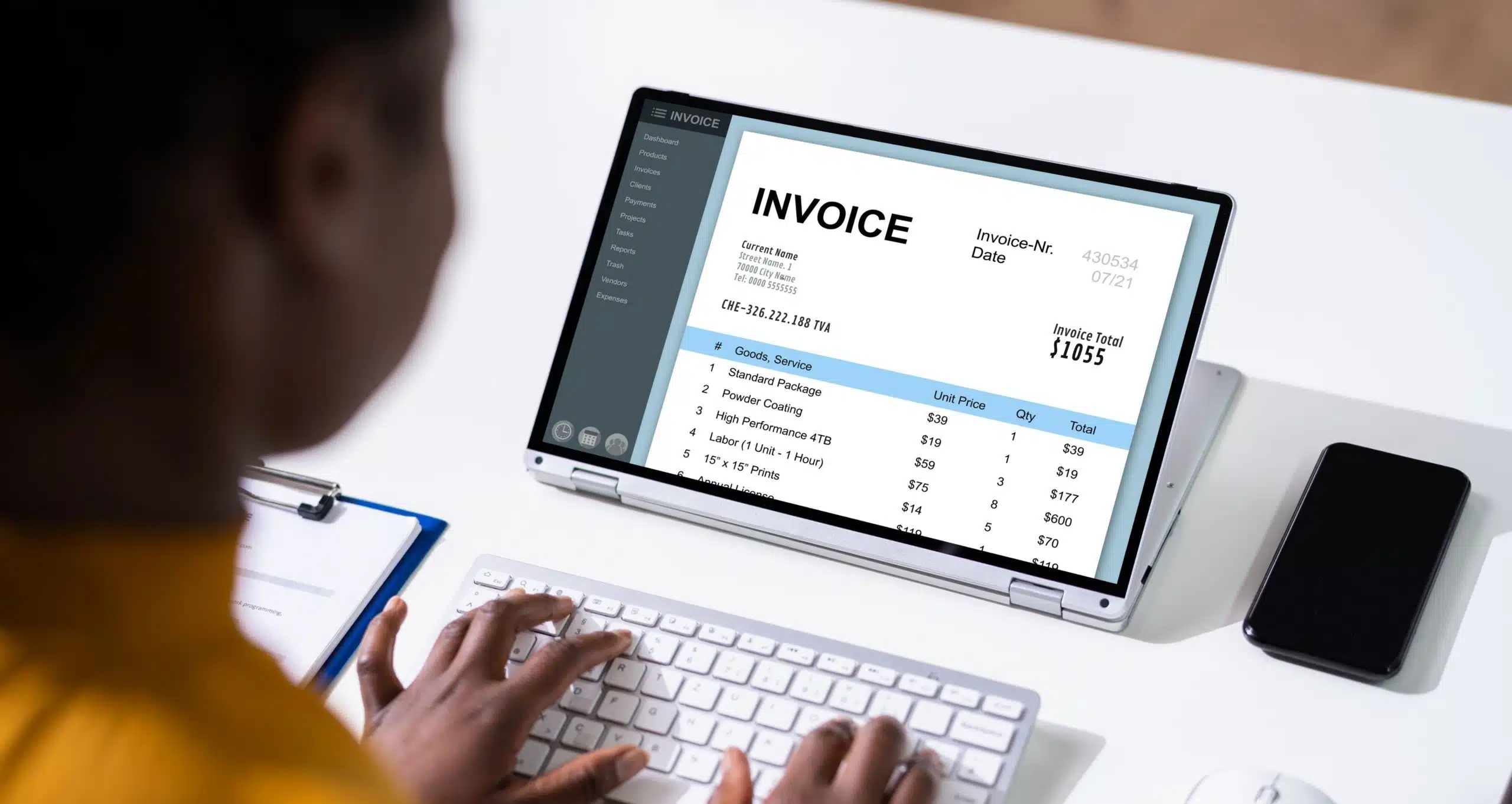
To find or check a Swiss VAT number, open the official UID register, search for the company name or UID, and read the VAT information in its record. Check the registration status and dates: having a CHE number does not, by itself, prove that VAT registration is active.
Compare the supplier’s identity and address with the invoice, then compare the date of the supply with the VAT registration period. For example, a register entry showing a start date of 1 January 2026 does not automatically justify VAT on a service supplied in December 2025. Ask the supplier to clarify the treatment; the UID alone does not settle it.
This article explains the Swiss VAT number format, how to look up a business and what changes when you register your own business for VAT.
At a glance
- A Swiss VAT number is based on the UID and takes the form “CHE-xxx.xxx.xxx TVA”.
- A business can have a UID without being VAT-registered.
- The official UID register lets you search for a business and check its VAT status.
- Switzerland is outside the EU’s intra-community VAT number system. A VIES search does not validate a Swiss VAT number.
- To obtain VAT status, register with the Federal Tax Administration (FTA) when registration is compulsory or you choose to register voluntarily.
Read feedback from entrepreneurs supported by Entreprendre.ch.



What does a Swiss VAT number look like?
The CHE prefix is followed by nine digits, usually displayed in three groups. For VAT purposes, the suffix is TVA, MWST or IVA, depending on the language. “CHE-123.456.789 TVA” illustrates the format; it is not intended here to identify a real business.
English documents commonly use the label “VAT number”. That does not create a different Swiss identifier. For the official suffix, the FTA accepts TVA, MWST or IVA, but not VAT. This is important when preparing an English-language invoice. The key is to identify both the business and its VAT registration, not simply recognise a number’s format.
| Term | What it identifies | Important distinction |
|---|---|---|
| UID, also called IDE in French | Swiss business identification number | It does not, on its own, prove VAT registration |
| VAT number | UID used with VAT status and the official VAT suffix | It is not an EU intra-community VAT number |
| Commercial register number | Identification in the commercial register context | Commercial registration is not the same as VAT registration |
| TIN, or NIF in French | Tax identification, depending on the context | Individuals and legal entities use different tax identification rules |
For a bank form or international request, our article on the Swiss tax identification number helps you identify which number is actually required.
What if the VAT number is missing or looks wrong?
First check for a typing error, an invoice issued under an old company name or a different legal entity. Ask the supplier for a corrected document if the identity or VAT details are unclear.
A formal defect in an invoice does not, by itself, settle every question of input VAT recovery. You must be able to establish that the supply took place, identify the supplier and meet the deduction conditions. Conversely, adding “TVA” after a UID yourself does not legitimise VAT that has been charged incorrectly.
Do not pay or deduct VAT simply because a document looks like a professional invoice. Our article on common Swiss VAT mistakes explains how to correct a return if the problem has already entered your accounts.
How do you obtain your own Swiss VAT number?
Assess your business’s VAT liability. The ordinary threshold is CHF 100,000 of relevant worldwide turnover, with exceptions and rules that depend on the activity. Below that threshold, voluntary registration is possible under the applicable conditions.
The UID is assigned through the business’s administrative identification process. Registration with the FTA adds the relevant VAT status. You do not need to buy a new number or sign up to a commercial directory.
Apply through the official VAT registration service. Provide the business details, describe the activity and establish the relevant turnover. The FTA then reviews the registration date and accounting arrangements.
Our article on Swiss VAT registration covers the threshold, deadlines, voluntary registration and choice of method. Assess these decisions before submitting the application; this article focuses on identifying and checking the number itself.
When should your VAT number appear on invoices?
When charging VAT as a registered business, include the information needed to identify the supplier correctly and show its VAT number. Also check the supply description, date or period, price and VAT treatment.
Do not start adding VAT just because you have received a UID. Check the effective date of your VAT liability. Equally, receiving the registration confirmation late does not necessarily mean that every earlier supply falls outside VAT.
Once the details are confirmed, update your invoicing software templates, quotations and relevant business documents. Our Swiss VAT article explains the applicable rates.
Why does VIES reject my Swiss VAT number?
VIES checks VAT numbers from participating EU countries. A Swiss CHE number is not an intra-community VAT number. Its absence from VIES therefore does not prove that the Swiss number is invalid.
Give your customer or supplier the UID register record or an appropriate VAT registration certificate. If your business also has a VAT registration in an EU country, that is a separate registration and should be used for the transactions to which it applies.
The number does not determine where an international sale is taxed. The type of supply, the customer and the place-of-supply rules remain decisive.
Check the status, not just the number
Use the official UID register to match the business, VAT status and relevant dates. A CHE number alone does not establish VAT registration. If you are setting up your own invoicing, complete the VAT registration assessment and use the required details on your Swiss invoices.
Frequently asked questions
Can a self-employed person have a Swiss VAT number?
Yes. A sole proprietorship can be liable for VAT. VAT registration is not restricted to limited companies and LLCs.
Do you have to pay to search the UID register?
The official register offers a public search. You do not need to pay a private directory to verify a number.
Does a CHE number mean the business can charge VAT?
No. Check its VAT status and registration period. The business identifier and VAT liability are separate pieces of information.
Where can I obtain proof of VAT registration?
The FTA provides a VAT registration certificate service. Use its official page to follow the procedure appropriate to your request.
Sources and updates
- Official UID register.
- FTA — enterprise identification number.
- FTA — VAT registration certificate (in French).
- FTA — VAT registration.
English editorial review: 22 September 2026. Key registration rules and official references checked against the FTA’s current information.

Romain Prieur is a Swiss-qualified chartered accountant and founder of Entreprendre.ch. Drawing on more than ten years of experience in audit and supporting Swiss businesses, he advises entrepreneurs on company formation, accounting and taxation.



How do you find a business’s Swiss VAT number?
Open the official UID register. Search using the company name or its UID if you know it. Where several results look similar, compare the exact registered name, address and legal structure with the invoice or contract.
Then check the record’s VAT information. You need a registration status, not merely a business with a similar name. An old company and a new business can use the same trading name while having different legal identities.
The invoice, legal notice or supplier’s website is a useful starting point, but use the official register to check the details. If the company belongs to a VAT group, review the group-specific information before assuming there is an error.
Why do the registration dates matter?
A business can register, deregister or change its situation. A current check is not always enough for an old invoice. Compare the available registration or deregistration dates with the date of the relevant supply.
If the register does not resolve the question, ask the supplier for confirmation or contact the FTA with the relevant details. Keep evidence of your check in the accounting file where the issue is material.