

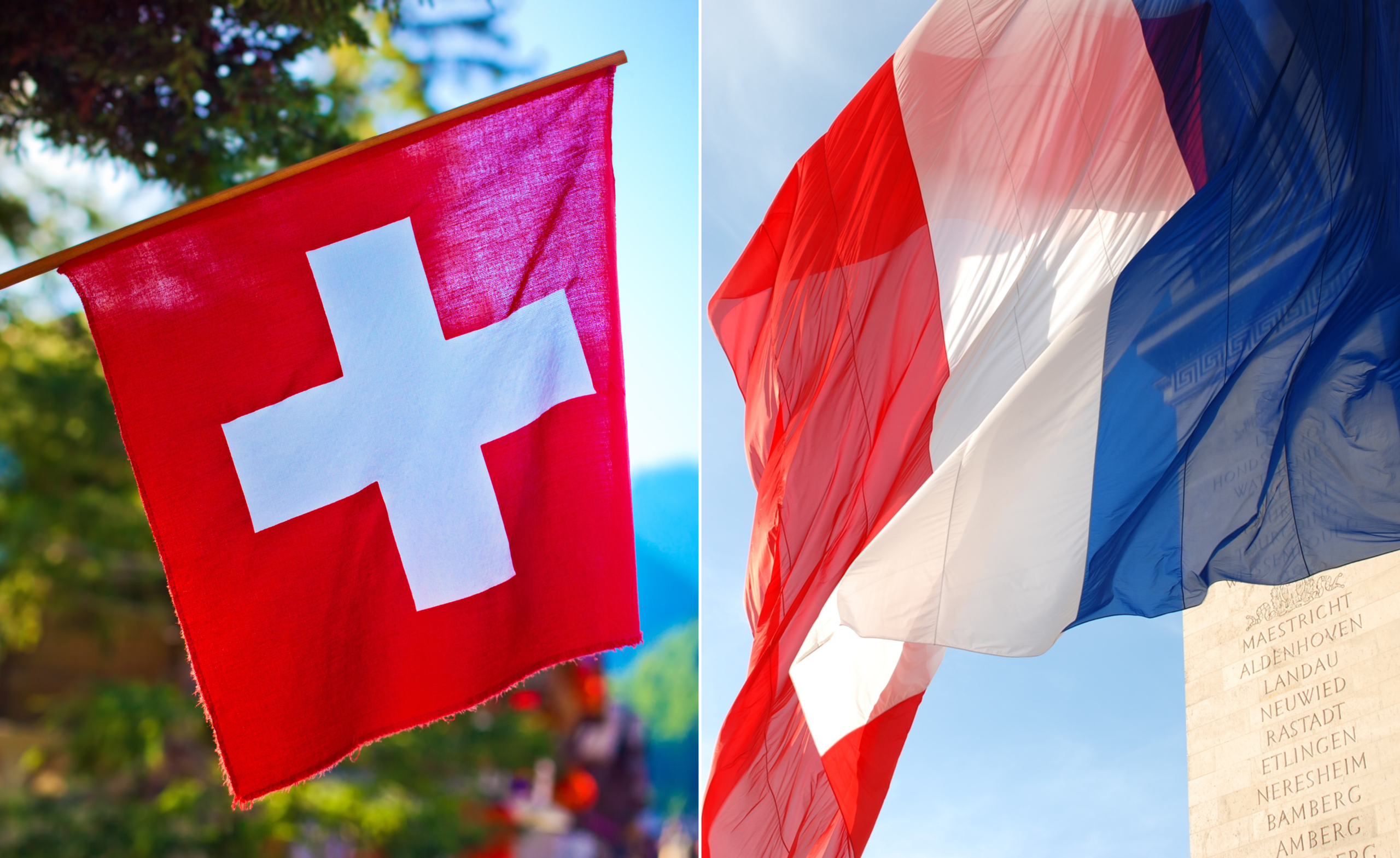
Comparing France’s “25% corporate tax rate” with a Swiss rate gives an initial indication, but it is not enough to decide where to build a business. Compare equivalent profit figures, take the company’s size into account and establish where its activities will actually be taxable.
This article concerns incorporated businesses, such as Swiss limited companies (SA/AG) and LLCs (Sàrl/GmbH), and companies subject to French corporate income tax, known as IS. The owner’s personal taxation is a separate step; it does not automatically follow the company’s tax position.
At a glance
- France’s standard corporate income tax rate is 25%. Eligible SMEs pay 15% on the first EUR 42,500 of taxable profit.
- Swiss corporate income tax combines federal, cantonal and communal taxes. The total depends on the location and applicable scale.
- Local taxes, capital tax, payroll and operating costs can change the comparison.
- Switzerland’s 8.1% VAT rate does not mean that every sale to a French customer can be invoiced at that rate.
- A Swiss address does not, by itself, make an activity managed or operated in France taxable only in Switzerland.
Read feedback from entrepreneurs supported by Entreprendre.ch. Reviews appear in their original language.



Which corporate tax rates should you compare?
France: the standard and reduced rates
The standard French corporate income tax rate is 25%. A 15% rate applies to the first EUR 42,500 of taxable profit for eligible companies: turnover excluding tax must not exceed EUR 10 million, capital must be fully paid up, and at least 75% must be held by individuals or meet the prescribed ownership conditions.
Profit above EUR 42,500 is taxed at 25%. A profitable small company therefore does not necessarily pay 25% on all its profit. Certain large groups may face additional contributions; the SME illustration here is not intended for them.
Switzerland: three levels of corporate income tax
The Confederation levies direct federal tax. Cantons and communes levy their own taxes on company profits. Tax deductibility must be considered when interpreting effective rates.
Switzerland does not have one single 12%, 14% or 15% corporate tax rate. A ranking usually refers to a specific municipality, year and profit level. Progressive or tiered scales can change an SME’s outcome.
Our comparison of corporate tax by canton covers French-speaking cantons and the differences in calculation methods. It avoids duplicating a second rate table here that could quickly become outdated.
Example: a company earning 200,000 in profit
Consider two separate companies to understand the calculations. The first has EUR 200,000 of taxable profit in France and qualifies for the reduced rate. The second has CHF 200,000 of pre-tax profit in Switzerland and, for illustration, faces a combined effective rate of 14%.
| Calculation | French company | Swiss company: assumed 14% rate |
|---|---|---|
| Starting profit | EUR 200,000 | CHF 200,000 |
| First French band | 42,500 × 15% = EUR 6,375 | Not applicable |
| Remaining French profit | 157,500 × 25% = EUR 39,375 | Not applicable |
| Corporate income tax | EUR 45,750 | CHF 28,000 |
| Profit after this tax | EUR 154,250 | CHF 172,000 |
The currencies differ: this table illustrates the calculations; it does not establish a saving of 17,750 after currency conversion. As a proportion of each scenario’s profit, French corporate tax represents 22.875% and the Swiss assumption 14%, a difference of 8.875 percentage points for this tax alone. That is not the net saving from establishing a business in either country.
To choose a location, convert both budgets into the same currency using an explicit exchange-rate assumption, then rebuild local costs and the owner’s tax position. The assumed 14% Swiss rate is not a tax quotation for Geneva or Lausanne.
A French company ineligible for the reduced rate would pay EUR 50,000 in this simplified example. These three outcomes show how a single headline percentage can conceal important differences.
Which other business taxes matter?
France: CFE and CVAE
The business property contribution, or CFE, depends in particular on the rental value of premises used for the activity, subject to minimum contribution rules and exemptions. It is not simply a percentage of profit.
CVAE, a contribution based on business value added, is generally payable where annual turnover excluding tax exceeds EUR 500,000 and the activity falls within its scope. A filing obligation can arise above EUR 152,500, subject to applicable exemptions. For 2026 and 2027, the maximum rate is 0.28%, under a scale linked to turnover. It applies to the statutory value-added base, not accounting profit, and is not the rate paid by every SME. Older rates of 1.5% or 0.75% are no longer appropriate for this comparison. See the French tax authority’s CVAE rules and thresholds (in French).
The abolition timetable has changed several times. Use official information for the relevant year, including supplementary taxes, instead of extrapolating an older timetable.
Switzerland: capital tax and particular transactions
Examine cantonal and communal capital taxes, including minimum charges, reliefs and any credit mechanisms. Other levies may apply to property or capital transactions.
Capital tax is not a direct equivalent of CFE or CVAE. Compare annual amounts based on your balance sheet and premises. Our Swiss business tax article explains the Swiss items to include.
VAT: what does 8.1% versus 20% actually mean?
Standard VAT is 8.1% in Switzerland and 20% in France. However, a transaction’s treatment depends on the place of supply, the goods or services sold, the customer’s status and import or reverse-charge rules.
A Swiss shop selling and shipping products to France cannot assume it will always charge French customers 8.1%. Consultancy supplied to a French business and a sale to a private customer may also follow different rules.
For a business that fully recovers VAT, the tax is often more of a reporting and cash-flow issue than a final expense. For private customers or activities without full recovery, the rate has a greater effect on the final price. Our Swiss VAT registration article distinguishes the obligation to register from the treatment of individual sales.
Where will the company actually be taxed?
Examine the registered office, place of effective management and any permanent establishments. If you incorporate in Switzerland but make decisions and operate from France, the analysis does not end with the Swiss commercial register extract.
Tax treaties allocate taxing rights; they do not give businesses a free choice of the lowest-tax country. Premises, staff, contracts and the real organisation must support the stated project. Related-party transactions also need defensible arm’s-length terms.
Before establishing the business, describe who makes decisions, who works, where they work, which customers they serve and what resources they use. That is more useful than simply looking for a cheap registered address.
Include the owner’s income and operating costs
Profit retained by the company is not your personal disposable income. You must still decide on salary or dividends, then consider the recipient’s tax residence, withholding taxes, social security contributions and treaty rules.
Our article on salary versus dividends in Switzerland explains the Swiss mechanisms. An owner resident in France needs an additional cross-border analysis.
Finally, compare recruitment costs, rent, insurance, travel, accounting and setup expenses. Lower tax on profit does not automatically offset higher running costs. Conversely, proximity to customers, available skills and market access can justify a location with a higher tax burden.
Prepare two forecast income statements in the same currency, followed by two personal budgets. Our business startup consultation can clarify the Swiss questions before you coordinate the French aspects.
Compare two complete business plans, not two headline rates
Use the same currency and consistent assumptions, then compare corporate taxes, operating costs and the owner’s disposable income. Establish where the business will actually be managed and operated. Understanding the Swiss tax system is a useful starting point, but a cross-border project also needs its French tax position assessed.
Frequently asked questions
Is Switzerland always cheaper for business taxes?
Not in every situation or for every tax. Compare profit, canton, commune, the applicable French rules and the owner’s remuneration together.
Can a Swiss company work with French customers?
Yes. Assess commercial requirements, VAT and any taxable presence in France. Having a French customer does not, by itself, determine the entire tax treatment.
Do sole proprietors use these corporate tax rates?
No. Individual entrepreneurs follow different rules. This comparison concerns companies subject to corporate income tax on their profits.
Sources and updates
- Service Public: French corporate income tax.
- BOFiP: CVAE rates for 2026–2027 and timetable (in French).
- BOFiP: calculation of CVAE (in French).
- FTA: taxation of legal entities (in French).
English editorial review: 22 September 2026. The numerical comparison illustrates the method; it is not an individual cross-border tax calculation.

Romain Prieur is a Swiss-qualified chartered accountant and the founder of Entreprendre.ch. With more than ten years of experience in audit and business advisory in Switzerland, he helps entrepreneurs with company formation, accounting and business taxation.


